Questions this answers
- What is the TokenLab Model Data Center?
- Which machine-readable model data endpoints are public?
- How should developers treat source dates and observed dates?
- Does Model Data Center replace provider docs?
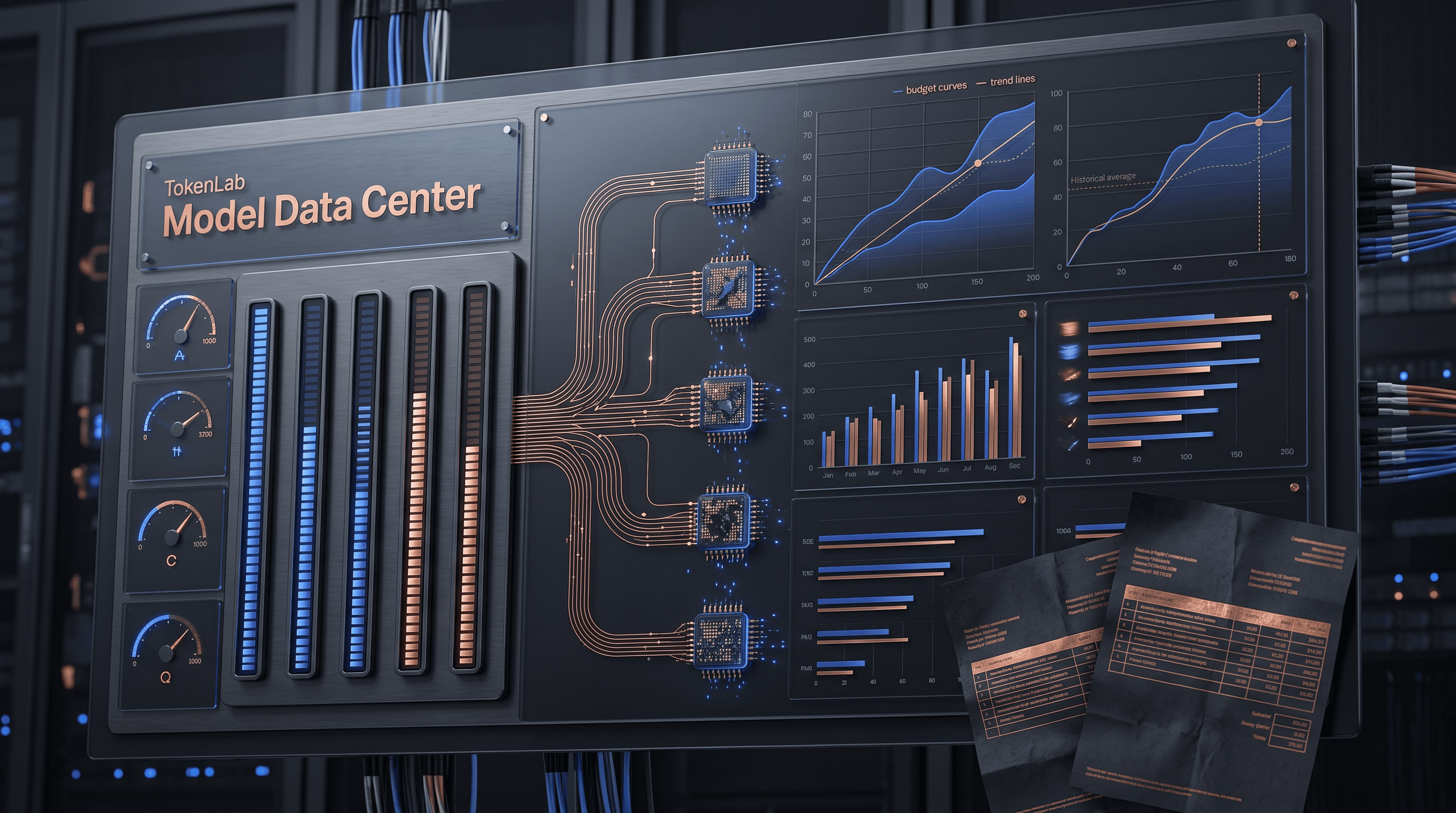
The TokenLab Model Data Center is a machine-readable model pricing catalog exposed through a live LLM pricing API, giving developers direct programmatic access to current provider rates and metadata.
Model markets move faster than editorial calendars. A pricing page written in May is often wrong by July. A "best model" ranking from last quarter can miss three new releases and one deprecation.
That mismatch is the reason TokenLab built a Model Data Center instead of another static comparison post. It is a public surface — pages for people, JSON and Markdown for machines — that carries a source label and an observed date on every claim it makes.
This article explains what the Model Data Center is, what it is not, and how to use it before you write a model comparison, wire an agent, or ship a pricing decision into production code.
Key Takeaways
- The Model Data Center is a public data layer split across five reader-facing pages and four machine-readable endpoints.
- Every dataset carries a
generatedAtandobservedAttimestamp plus asourcePolicyfield so you know whether a number is provider-reported, TokenLab catalog data, or a reference signal like a leaderboard. - Catalog data, trend snapshots, and research interpretation are kept as separate surfaces on purpose — they answer different questions and should not be blended.
- The public JSON is designed to share verified facts, not internal implementation details.
- None of this replaces official provider documentation for exact pricing, lifecycle, or safety claims. Treat it as a fast, dated starting point, then verify against the source.
For the full dataset and schema details, see the TokenLab Model Data Center.
Why a Dedicated Data Center, and Not Another Blog Post
A blog post is a snapshot with a publish date. A data center is a live surface with a refresh cadence and a policy for what counts as truth.
The distinction matters for three groups of readers:
Developers who need to pick a model for a feature this week, not last quarter. They want current context windows, modality support, and per-million-token pricing without reading five provider changelogs.
Agents and crawlers that need structured JSON they can parse without scraping prose. An agent comparing input-token cost across providers should not have to guess which paragraph in a blog post is still accurate.
Research readers who want the reasoning behind a ranking — why a model moved up or down, what the tradeoffs are — not just a number.
TokenLab splits these needs across distinct pages rather than trying to serve all three from one document. That is the core design decision behind the Model Data Center.
What Each Page Is For
The Model Data Center is not one page. It is a set of five, each answering a different question.
Models — the entry point
tokenlab.sh/en/models is the human-readable directory: what TokenLab lists, organized by provider and category. Start here if you want to browse rather than query.
Data — the catalog view
tokenlab.sh/en/models/data is the structured catalog: model IDs, providers, context lengths, modalities, and pricing fields laid out for direct comparison. This is the page to cite when you need a specific fact about a specific model.
Trends — the movement view
tokenlab.sh/en/models/trends tracks how the catalog changes over time — new listings, pricing shifts, provider activity. This answers "what changed" rather than "what is true right now."
Research — the interpretation view
tokenlab.sh/en/models/research is where TokenLab explains reasoning: why a ranking moved, what a pricing shift implies, where sources disagree. Treat this as analysis, not raw data.
Rankings — the comparison view
tokenlab.sh/en/models/rankings surfaces ordered comparisons — by price, by context window, by category — built from the same underlying catalog as the data page, but organized for ranking rather than lookup.
The separation is deliberate. If you conflate "what changed this week" with "what is true today," you end up citing stale trend deltas as current facts. Keeping trends, catalog data, and research as distinct surfaces avoids that failure mode.
The Machine-Readable Layer
Pages are for people. The following four endpoints are for anything that parses JSON or Markdown — agent pipelines, internal tooling, or a script that checks pricing before a deploy.
| Endpoint | Format | Primary use |
|---|---|---|
/model-data/catalog.json |
JSON | Full model catalog: IDs, providers, context, modality, pricing fields |
/model-data/latest.json |
JSON | Most recent snapshot, generation timestamp, catalog hash |
/model-data/trends.json |
JSON | Time-series deltas for pricing and listing changes |
/model-data/summary.md |
Markdown | Human-and-LLM-readable summary, suited for direct citation in generated text |
Querying the TokenLab Model Data Center Programmatically
Before integrating this data into pipelines or agents, inspect the generatedAt, observedAt, and catalogHash fields to understand when the catalog was produced and whether it has changed since your last fetch. Do not assume the feed updates in real time; always check these fields rather than relying on an assumed refresh interval.
curl -s https://tokenlab.sh/model-data/latest.json | jq '{
  generatedAt: .generatedAt,
  observedAt: .observedAt,
  catalogHash: .catalogHash
}'
Compare catalogHash across requests to detect actual content changes, and use generatedAt/observedAt to gauge data freshness before making pricing decisions in automated systems.
Each response includes a consistent set of fields: schemaVersion, generatedAt, observedAt, catalogHash, sourcePolicy, stats, models, series, providers, and trends. If you are building automation against these endpoints, schemaVersion and catalogHash are the two fields to check before trusting a cached copy — a version bump or hash change means the shape or content moved since your last pull.
The sourcePolicy field is worth reading closely. It distinguishes three tiers: provider documentation (the highest-trust source for exact pricing and lifecycle facts), TokenLab's own catalog (what TokenLab can publicly present), and reference signals (third-party leaderboards and rankings, useful for relative positioning but not pricing truth). Any downstream tool that ignores this distinction risks quoting a leaderboard score as if it were an official price.
What the public JSON deliberately leaves out
The public data contract is scoped deliberately: it includes only the model facts needed for integration — IDs, pricing, and modality support — and leaves out internal operating details that aren't part of that contract. If you're looking for how TokenLab makes decisions behind the scenes, this isn't the surface for it, and it isn't meant to be. The Model Data Center publishes what is safe and useful to share publicly — current model facts — not internal operating details.
Reading Current Model Facts Correctly
The catalog is only useful if you read dates and sources alongside the numbers. Here is a small, current-as-of-observation example set, drawn from the same kind of fields the public catalog exposes: model ID, provider, context length, modality, and per-million-token pricing.
| Model | Provider | Context | Modality | Input / Output (USD per M tokens) |
|---|---|---|---|---|
| Claude Sonnet 5 | Anthropic | 1,000,000 | text+image+file→text | $2 / $10 |
| Gemini 3.5 Flash | 1,048,576 | text+image+file+audio+video→text | $1.50 / $9 | |
| DeepSeek V4 Pro | DeepSeek | 1,048,576 | text→text | $0.435 / $0.87 |
| DeepSeek V4 Flash | DeepSeek | 1,048,576 | text→text | $0.09 / $0.18 |
| GLM-5.2 | Z.ai | 1,048,576 | text→text | $0.909 / $2.856 |
| Kimi K2.7 Code | MoonshotAI | 262,144 | text+image→text | $0.74 / $3.50 |
A few things stand out immediately from a table like this, and they are the kind of thing the Data Center is built to make visible fast:
- Context window size does not track with price. DeepSeek V4 Pro and Gemini 3.5 Flash both sit near or above 1M tokens of context at very different price points.
- Modality breadth (text vs. text+image vs. multi-modal) is a separate axis from cost — a wider modality list does not automatically mean a higher per-token price.
- Coding-specialized models like Kimi K2.7 Code carry pricing and context tradeoffs distinct from general-purpose chat models, even within a similar context-length range.
None of these observations replace reading the provider's own documentation before you commit pricing assumptions into a contract or a billing model. They are a starting comparison, not a final one.
A Practical Checklist Before You Cite a Model Fact
Use this before you paste a model price, context window, or ranking into a comparison post, a customer-facing doc, or agent logic.
- Check the observed date. Every dataset carries
observedAtandgeneratedAt. If either is more than a few days old relative to your use case, treat the numbers as a starting point, not a final answer. - Identify the source tier. Is this a provider-documented fact, a TokenLab catalog entry, or a reference signal like a leaderboard? Reference signals are for relative positioning, not exact pricing.
- Separate catalog from trend. A trend delta ("price dropped 20% this month") is not the same claim as a catalog fact ("current price is $X"). Cite the right surface for the right claim.
- Check
catalogHashbefore caching. If you are pulling/model-data/catalog.jsonon a schedule, compare the hash before assuming your cached copy is still current. - Verify pricing and lifecycle claims against official docs. The Data Center is fast and structured. It is not a substitute for a provider's own pricing page when money or contracts are involved.
- Note disagreement, don't average it away. If a leaderboard signal and a catalog fact disagree, that disagreement is itself information. Report it rather than picking one silently.
Where This Fits Next to Provider Docs
The Model Data Center exists because scattered provider docs are hard to compare quickly, and marketing pages are not built for citation. It is not trying to replace either.
Provider documentation remains the source of record for exact pricing, rate limits, deprecation timelines, and safety policy. TokenLab's catalog and trend data are built from a documented source policy — largely third-party model listing data plus TokenLab's own public availability — refreshed on a defined cadence, and labeled with when they were observed.
If you need to make a decision with financial or compliance weight — a production pricing model, a contract term, a regulated-industry deployment — go to the provider's own page as the final check. Use the Model Data Center to get there faster and to compare across providers in one place.
FAQ
What is the TokenLab Model Data Center? It is a public set of pages and machine-readable endpoints that present current AI model facts — pricing, context windows, modality, provider, and comparative rankings — with a stated source and an observed date on every dataset. It is split into browsing pages (models, data, trends, research, rankings) and structured feeds (catalog, latest snapshot, trends, and a Markdown summary).
Which machine-readable model data endpoints are public?
Four: /model-data/catalog.json for the full model catalog, /model-data/latest.json for the most recent snapshot with generation metadata, /model-data/trends.json for time-series changes, and /model-data/summary.md for a Markdown summary suited to direct citation.
How should developers treat source dates and observed dates?
As a freshness signal, not a guarantee of permanence. Every dataset includes generatedAt and observedAt fields. If those dates are old relative to when you are reading, re-check the source before relying on the number, especially for pricing that changes frequently.
Does Model Data Center replace provider docs? No. It replaces the need to manually collect and compare scattered provider pages for a first pass. For exact pricing, lifecycle, rate limits, and safety claims that carry financial or compliance weight, official provider documentation remains the source of record.
Sources and Freshness
All facts and endpoint descriptions in this article were observed on 2026-07-09 from the following public sources:
- TokenLab Model Data Center —
https://tokenlab.sh/en/models/data - TokenLab Model Trends —
https://tokenlab.sh/en/models/trends - TokenLab Model Research —
https://tokenlab.sh/en/models/research - TokenLab model data catalog JSON —
https://tokenlab.sh/model-data/catalog.json
Model pricing, context length, and modality figures referenced in the comparison table reflect TokenLab's current-model source-of-truth snapshot observed 2026-07-07 and are subject to change on the refresh cadence documented in the catalog's sourcePolicy field. Verify current figures against the live endpoints or official provider documentation before using them in a financial or compliance context.
Next Steps
If you are writing a model comparison, start at /en/models/data for the catalog view and cross-check against /en/models/rankings for relative positioning.
If you are building an agent or automation that needs to reason about model pricing or availability, pull /model-data/latest.json on a schedule and check catalogHash before trusting a cached copy.
If you want the reasoning behind a ranking shift rather than just the number, read /en/models/research — it is where TokenLab explains what moved and why.
If you're weighing costs alongside capability, our breakdown of Gemini API pricing for developers offers a closer look at current rates. For a broader comparison across coding-focused models, see our guide to the best AI models for coding in 2026.
Start exploring the Model Data Center to query current model pricing directly.
Sources
Price observed 2026-07-09
- TokenLab Model Data CenterObserved 2026-07-09
- TokenLab Model TrendsObserved 2026-07-09
- TokenLab Model ResearchObserved 2026-07-09
- TokenLab Model RankingsObserved 2026-07-09
- TokenLab model data catalog JSONObserved 2026-07-09
- TokenLab latest models JSONObserved 2026-07-09
- TokenLab model data summaryObserved 2026-07-09