Questions this answers
- What changed in TokenLab Async Image Generation Tasks for Production Apps?
- Who should use this TokenLab update?
- How should developers verify current model, pricing, or API details?
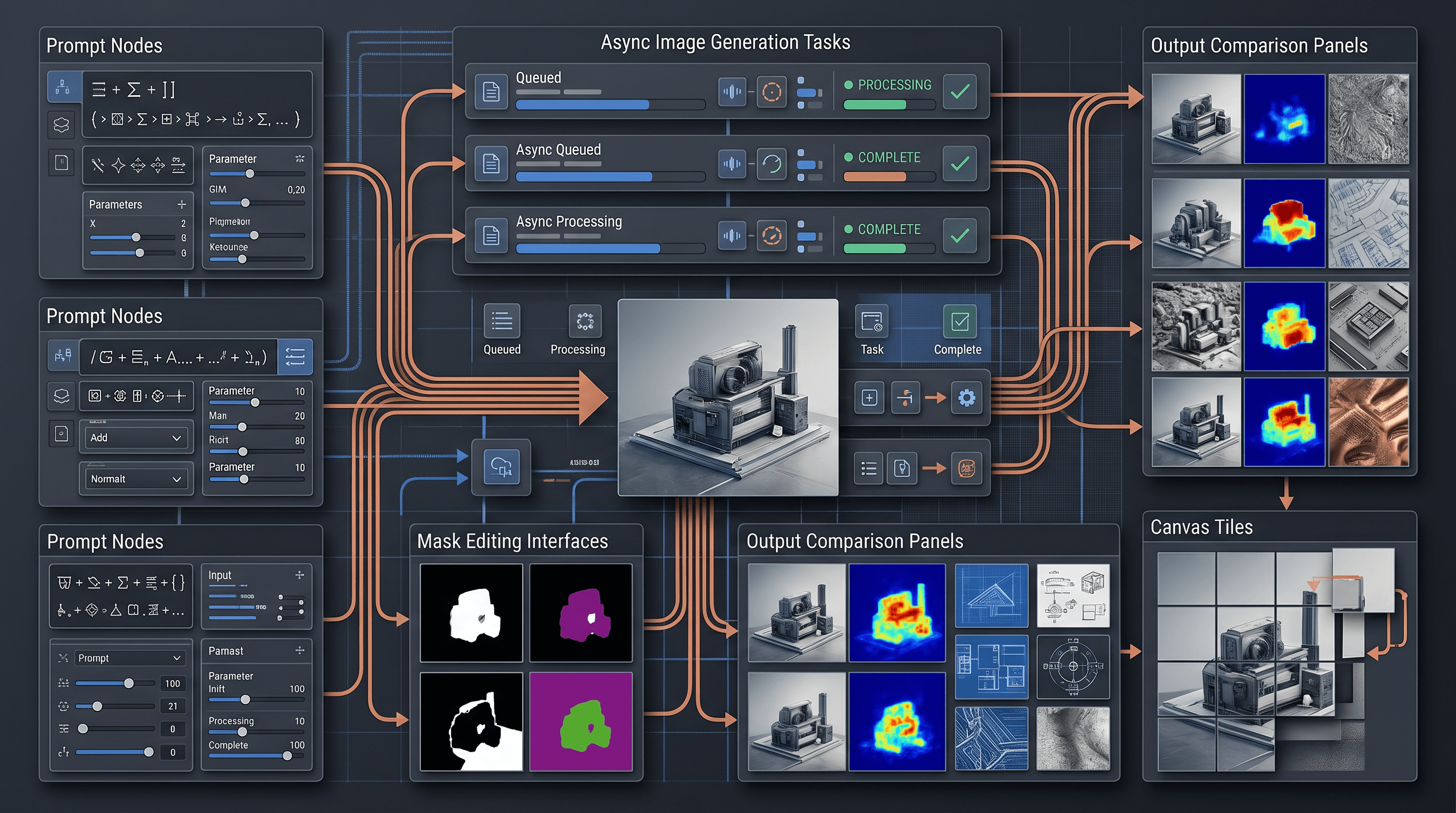
If your image generation or image edit workload takes more than a few seconds, stop holding a connection open and start polling. TokenLab now supports async task handling across image generation and editing so you can submit a job, walk away, and check back when it's done instead of tying up a request thread waiting on a slow render.
Key Takeaways
- Long-running image jobs (high-resolution outputs, multi-image edits, batch renders) should use async task creation, not blocking calls.
- The pattern is simple: create the task, save the task id, poll for status, retrieve the result URLs on completion.
- Async tasks avoid client timeouts, reduce wasted compute on abandoned requests, and let you queue work at scale.
- Sensible polling intervals and timeout ceilings matter more than raw request speed for a stable production integration.
Why Blocking Requests Break Down for Image Work
Text generation is mostly bounded and predictable. Image generation is not. A single high-resolution render, a multi-image edit pass, or a batch of product photos can take anywhere from a few seconds to well over a minute depending on model and settings. If your app holds an HTTP connection open for that entire duration, you inherit every problem that comes with long-lived synchronous calls: client timeouts firing before the job finishes, load balancers or proxies killing idle connections, and no clean way to retry without starting the whole job over.
Async task handling decouples job submission from job completion. You get an immediate response with a task id, your app moves on, and you check status on your own schedule. This is the same pattern most mature APIs use for anything that isn't near-instant, and it's now available for image generation and image editing on TokenLab.
The Async Workflow
The flow has four steps, and it stays the same whether you're generating a single image or editing several:
- Create the task. Send your generation or edit request as usual, but request async mode. Instead of waiting for pixels, you get back a task id (or a poll URL) right away.
- Store the task id. Persist it against whatever business object it belongs to - an order, a user upload, a batch job row. If your process restarts, you should be able to resume polling without losing track of in-flight work.
- Poll until the task reaches a terminal state. Check status on an interval. The task will report
queued,processing,completed, orfailed. Don't treat anything other thancompletedorfailedas done. - Retrieve the output. Once
completed, the response includes the URLs for your generated or edited images. Fetch and store them on your side - don't assume the URLs are valid indefinitely.
For the exact request and response shapes, see the create image and edit image references, and the dedicated async jobs and polling guide for status codes and edge cases.
When to Use Async vs. Synchronous Calls
Not every image call needs to go async. Use this as a rough decision guide:
| Scenario | Recommended mode |
|---|---|
| Single low-resolution image, fast model, interactive UI | Synchronous |
| High-resolution output (large canvas, upscaled) | Async |
| Multi-image edit (combining or modifying several inputs) | Async |
| Batch product imagery (catalog runs, variant sets) | Async |
| Background creative generation not tied to a live user wait | Async |
| Any workflow where you can't guarantee a client will stay connected for 30+ seconds | Async |
The general rule: if a human is staring at a spinner for more than a few seconds, or if the job runs as part of a batch, use async. Interactive, low-latency image tweaks are still fine synchronous.
Production Polling Checklist
Poor polling behavior is the most common way teams turn a good async setup into a flaky one. Use this checklist before shipping:
- Use exponential backoff, not fixed-interval hammering. Start with a short interval (1-2 seconds) and back off as the task stays in
processing, rather than polling every 200ms for a minute straight. - Set a maximum poll duration per task. Decide upfront how long you'll wait before treating a task as stalled (for example, 3-5 minutes for high-resolution or multi-image jobs), and handle that case explicitly rather than polling forever.
- Handle
failedstatus distinctly from timeout. A task that returnsfailedhas a reason attached - surface it. A task that never resolves within your ceiling is a different failure mode and should be logged separately. - Make polling idempotent and resumable. Store task ids so a crashed worker or redeployed service can pick up polling where it left off instead of losing track of in-flight jobs.
- Don't poll from the client if you can avoid it. Poll from your own service layer and push a completion event or webhook-style notification to the client. This avoids leaking retry logic and task ids into frontend code.
- Cap concurrent polling requests. If you have hundreds of tasks in flight, batch your status checks or stagger them rather than firing one request per task every interval.
- Download and store result URLs promptly. Once a task completes, treat the returned URLs as short-lived. Pull the images into your own storage as part of the same workflow that marks the task complete.
Where This Fits in a Real Pipeline
A common pattern: a merchandising tool submits a batch of product shots for background replacement using image edit, each as its own async task. The service stores each task id against a product record, polls on a shared interval with backoff, and marks each product's imagery as ready as tasks complete. Failed tasks get flagged for manual review instead of silently blocking the batch. Nothing in the batch depends on a single long-held connection, so a deploy or restart mid-batch doesn't lose work - the task ids are already persisted, and polling resumes cleanly.
This same shape works for creative teams queuing overnight batch renders, apps generating high-resolution assets for print, or any workflow where "eventually correct" beats "immediately blocking."
Reliability Checks Before Launch
Async media jobs fail in ways that simple text completions usually do not. A request can be accepted and still fail later. A user can close the browser before the result is ready. A worker can restart while hundreds of tasks are in queued or processing. A provider can complete the image but return a URL that expires before your app downloads it. Treat all of those as first-class states in your design rather than edge cases.
Before launch, run a small batch that deliberately includes long prompts, large image sizes, edits with multiple source assets, and invalid inputs. Confirm that each path produces a durable status record, a visible failure reason, and no duplicate billing action in your own system. Then test a deploy or worker restart while jobs are still in flight. If polling resumes from stored task ids and completed assets are copied into your storage exactly once, the async layer is ready for real traffic.
FAQ
Do I need to change my request payload to use async mode? You add an async flag or use the async-specific endpoint variant documented in the create and edit image references. The core generation parameters (prompt, size, edit inputs) stay the same - only the response and follow-up flow change.
What happens if I poll too aggressively? Excessive polling doesn't speed up task completion - it just adds load to your own service and to the API. Use backoff as described above. There's no benefit to sub-second polling intervals for jobs that typically take tens of seconds.
Can I cancel a task once it's created? Check the async jobs and polling guide for current cancellation support and status transition details, since this can vary by task type.
Sources and Freshness
This article reflects TokenLab's async image generation task support as observed on 2026-07-07. API behavior and status field names may evolve - always check the linked reference docs for the current schema before shipping.
Ready to move slow image jobs off the request-response path? Check the async jobs and polling guide and start queuing your high-resolution and batch image work through TokenLab today.
Related Reading and Next Step
Async image generation is only half the picture. Choosing the right model matters just as much as handling job queues correctly. If you're deciding between providers, GPT Image API vs Gemini Image API: How to Choose breaks down quality, speed, and format differences. For editing workflows layered on top of generation, the Nano Banana API Guide: Image Generation and Editing Through TokenLab covers practical implementation patterns. Before scaling any of this into production traffic, run the numbers using the AI API Cost Calculator Guide: Estimate Spend Before You Ship to avoid surprises at volume.
Model availability and pricing change frequently, so verify current details before relying on any provider for high-volume production use.
Ready to test async image generation in your own stack? Create an API key and start building today.
Sources
Price observed 2026-07-07
- TokenLab image generation API docsObserved 2026-07-07
- TokenLab image edit API docsObserved 2026-07-07
- TokenLab async jobs guideObserved 2026-07-07