Questions this answers
- What is agent model fallback routing?
- How does a max_price guard prevent surprise costs during fallback?
- Which models should I include in a fallback chain for low‑cost agent routing?
Agent model fallback routing keeps your application resilient when a primary AI model becomes unavailable or too expensive, and it does so automatically without manual swaps. By defining ordered backup models and cost caps, you avoid downtime and budget spikes.
Key Takeaways
- Fallback routing automatically switches to a secondary or tertiary model if the primary fails, times out, or exceeds a cost threshold.
- Pairing fallback logic with per-request price limits is the only reliable way to prevent surprise spend from a runaway fallback chain.
- Both TokenLab and OpenRouter provide native fallback configuration via their API, allowing you to define ordered model lists without bespoke retry loops.
- Testing your fallback strategy under load reveals latency tradeoffs and helps you fine-tune model order based on actual performance data.
What Is Agent Model Fallback Routing?
Fallback routing is a resilience pattern that replaces the failed or costly invocation of one model with an alternative model, continuing the request without user-visible errors. In AI-powered agents, where a single call to a large language model might affect a multi-step workflow, this pattern matters at every layer.
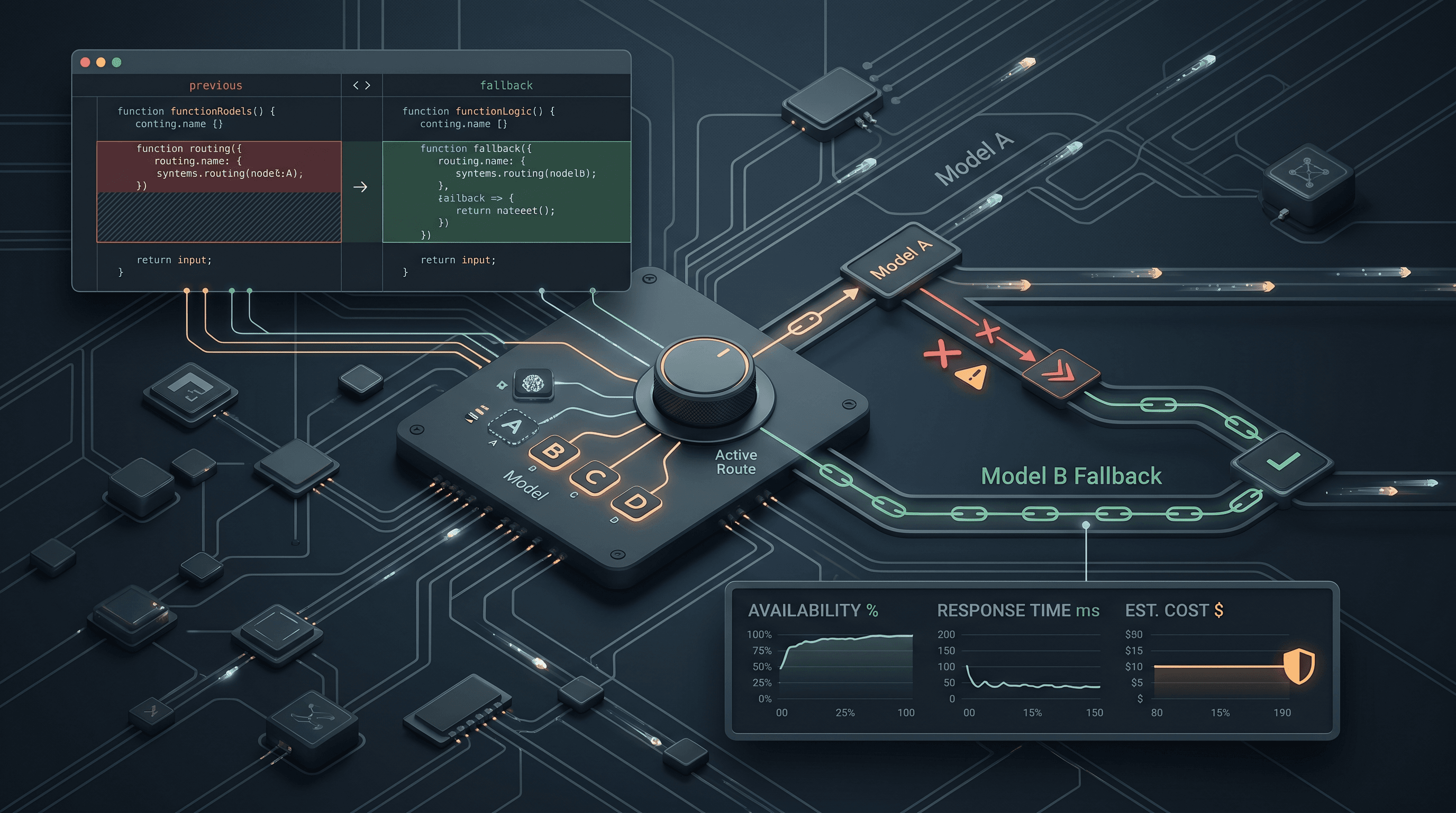
Conceptually, you supply an ordered list of models: primary, secondary, tertiary. The request tries the first model. If it returns a 5xx error, hits a rate limit, or crosses a budget boundary, the platform automatically retries with the next model in the sequence. The outcome is that the end user, or the agent logic, receives a valid response as long as at least one model succeeds.
According to developer documentation, OpenRouter describes this as providing an array of models in the models parameter; the service attempts each in turn. TokenLab’s API exposes the same capability through the model field, which accepts an ordered array, plus an optional max_price parameter to cap total cost per call.
Why Fallback Routing Matters for Agent Reliability
Agents that chain multiple LLM calls are exposed to cumulative failure risk. A single unavailable model endpoint can break a conversation loop, a tool-calling sequence, or a code generation pipeline. Fallback routing decouples the agent from any one provider’s availability or pricing fluctuations.
When selecting models for your fallback chain, you must balance capability and cost. For example, if your primary model is a flagship text model like Claude Fable 5 or GPT-5.5, falling back to another flagship model like Claude Opus 4.8 preserves intelligence but might increase latency or cost. Alternatively, falling back to a low-cost routing model like DeepSeek V4 Flash, GLM-5.2, or Gemini 3.5 Flash keeps costs low and ensures fast execution, though it may reduce reasoning depth.
To understand how these models compare in price and performance, you can review the TokenLab pricing comparison and the OpenRouter comparison to design an optimal routing hierarchy.
Implementing Fallback Routing: Code Example
To implement fallback routing programmatically, you can pass an array of models to your API client. The following example demonstrates how to configure a fallback sequence using TokenLab's API, routing from a primary coding model to a series of backup models while enforcing a maximum price cap to prevent surprise spend.
import requests

# Define your fallback chain using current models
# Primary: Claude Sonnet 5 (high capability)
# Secondary: DeepSeek V4 Pro (strong open-weight alternative)
# Tertiary: DeepSeek V4 Flash (low-cost fallback)
fallback_models = ["claude-sonnet-5", "deepseek-v4-pro", "deepseek-v4-flash"]

payload = {
    "model": fallback_models,
    "messages": [
        {"role": "system", "content": "You are an expert coding assistant."},
        {"role": "user", "content": "Write a thread-safe connection pool in Python."}
    ],
    "max_price": 0.015,  # Cap the maximum price per million tokens to avoid surprise spend
    "temperature": 0.2
}

headers = {
    "Authorization": "Bearer YOUR_TOKENLAB_API_KEY",
    "Content-Type": "application/json"
}

response = requests.post(
    "https://api.tokenlab.sh/v1/chat/completions",
    json=payload,
    headers=headers
)

result = response.json()
print(f"Active model used: {result.get('model')}")
print(f"Response: {result['choices'][0]['message']['content']}")
In this implementation, if Claude Sonnet 5 experiences a rate limit or service interruption, the router automatically attempts the request with DeepSeek V4 Pro. If that also fails, it falls back to DeepSeek V4 Flash. The max_price parameter ensures that if any model in the chain exceeds your budget threshold, the router halts the execution rather than incurring unexpected costs.
Designing Your Fallback Strategy
A successful fallback strategy requires grouping models by task type to ensure that the backup model can handle the specific demands of the workload.
Coding and Reasoning Agents
For software engineering agents, you need models that excel at syntax, logic, and system design. If your primary coding model fails, your backup must possess comparable reasoning capabilities.
- Primary: Claude Sonnet 5
- Secondary: Kimi K2.7 Code or DeepSeek V4 Pro
- Tertiary: Gemini 3.5 Flash (for fast, cost-effective code generation)
To find the best options for these tasks, refer to the guide on the best AI models for coding in 2026.
Low-Cost Text and Chat Agents
For high-volume customer support or data extraction agents, minimizing cost per token is the primary objective.
- Primary: DeepSeek V4 Flash
- Secondary: GLM-5.2 or Qwen3.7 Plus
- Tertiary: Laguna XS 2.1 or MiniMax M3
Multimodal and Image Generation Agents
When working with image generation or analysis, your fallback chain must support the same input and output modalities.
- Primary: Nano Banana Pro (Gemini 3 Pro Image)
- Secondary: Nano Banana 2 (Gemini 3.1 Flash Image)
- Tertiary: GPT Image 2 or Reve 2.0
For a complete breakdown of available visual models, consult the directory of the best AI image models API in 2026.
Video Generation Agents
If your agent orchestrates video generation pipelines, you need a robust fallback sequence to handle high-latency video generation APIs.
- Primary: Seedance
- Secondary: Veo 3 or Kling
- Tertiary: Hailuo, Vidu, or PixVerse V6
To evaluate performance across these video options, check out our guide on the best AI video models API in 2026.
Fallback Implementation Checklist
Use this checklist to verify that your fallback routing setup is secure, cost-controlled, and optimized for performance.
| Verification Step | Description | Target Status |
|---|---|---|
| Model Compatibility | Ensure backup models support the same parameters (e.g., system instructions, tool calling, JSON mode). | Required |
| Max Price Caps | Configure a max_price limit on every request to prevent expensive models from running up bills during primary outages. |
Required |
| Timeout Configuration | Set aggressive timeouts (e.g., 5 to 10 seconds) on primary models so the fallback triggers quickly. | Recommended |
| Error Logging | Track which models are actively used in production to identify persistent provider issues. | Recommended |
| Context Window Alignment | Verify that backup models can handle the context length of the incoming prompt. | Required |
Method and Evidence Notes
Fallback routing is not just a retry loop. The useful comparison is between router behavior, provider availability, model capability, and the cost ceiling you can tolerate for the workflow. OpenRouter's documentation is useful for understanding ordered fallback semantics in an aggregator surface. Fireworks' router/provider framing helps distinguish the company receiving an API request from the infrastructure actually serving the model. Braintrust's router guide is useful for observability and eval-driven routing vocabulary. RouteLLM provides the research frame for cost-quality routing, but it still assumes measured preference or workload data.
For a production agent, keep the evidence boundary explicit. Public docs can confirm that a platform supports ordered model lists or router concepts. They cannot prove that your fallback chain will preserve tool-call accuracy, JSON shape, or domain-specific quality. Before shipping, replay representative agent traces with forced primary failures, rate-limit responses, and price-cap failures. The route is only reliable if the fallback model can complete the same contract the agent expects.
Frequently Asked Questions
How does fallback routing affect API latency?
Fallback routing can increase latency when the primary model fails, as the system must wait for the primary request to timeout or return an error before initiating the secondary request. You can mitigate this by setting tight timeout limits (such as 5 seconds) on the primary model, ensuring a swift transition to the backup model.
Will fallback models support the same system prompts and tools?
Not always. While basic text generation is highly portable, advanced features like tool calling, structured JSON outputs, and system prompt formatting vary between models. When setting up a fallback chain, ensure your backup models (such as Kimi K2.7 Code or GLM-5.2) support the exact API parameters required by your agent.
How do I prevent a fallback chain from choosing a highly expensive model?
You should always define a hard price cap using parameters like max_price in your routing configuration. If a primary low-cost model fails, this cap prevents the router from automatically selecting an expensive frontier model that would exceed your budget.
Get Started with Reliable Routing
Building resilient AI agents requires constant monitoring of model performance, pricing, and availability. To find the most reliable and cost-effective models for your fallback chains, explore the live data on the TokenLab AI Model Leaderboard. For a comprehensive list of all supported endpoints and pricing structures, visit the TokenLab model directory (observed 2026-07-07).
Once fallback routing is live, don't treat it as set-and-forget. Watch your fallback trigger rate weekly; a sudden spike usually means your primary model is degrading or hitting capacity limits upstream. Log which fallback tier actually resolves each request so you can prune unnecessary hops and keep latency predictable. Revisit cost assumptions periodically too, since model pricing shifts, as observed in the TokenLab model directory on 2026-07-07. Set alerts on spend deltas, not just error rates, so a misconfigured fallback chain doesn't silently burn budget. Treat your routing config as code: version it, test it against real failure scenarios, and review it during incident postmortems. Get Started with TokenLab to set this up without guesswork.
Sources
Price observed 2026-07-07
- TokenLab API docsObserved 2026-07-07
- OpenRouter docsObserved 2026-07-07
- Braintrust LLM router guideObserved 2026-07-09
- Fireworks inference providers vs API routersObserved 2026-07-09
- RouteLLM paperObserved 2026-07-09