Questions this answers
- Can Cursor use any model through TokenLab, or only the built-in defaults?
- Does Cline support extended thinking mode through a BYOK gateway?
- Why can't I use TokenLab as a generic OpenAI-compatible endpoint in Windsurf?
Key Takeaways
- A single TokenLab API key and base URL unlock any OpenAI-compatible endpoint in your editor, giving you access to 300+ models beyond the built-in defaults.
- Cursor supports custom API keys for standard chat models and is the smoothest mainstream editor choice for multi-model workflows.
- Cline offers the widest provider flexibility, including Anthropic-native protocol support for extended thinking features, and is the best place to configure a BYOK (Bring Your Own Key) gateway.
- Windsurf's BYOK support is limited to specific Claude models on individual plans; it does not act as a generic OpenAI-compatible surface.
AI coding assistants usually lock you into a handful of default models. Cursor ships with GPT-5.5 and Claude Sonnet 5, Cline defaults to Claude, and Windsurf provides its own curated model list. If you want to try DeepSeek V4 Flash for cheap iterative loops, Gemini 3.5 Flash for long-context tasks, or any other model outside that predefined set, the built-in menus won't get you there. Routing through TokenLab with a single API key gives every one of these editors access to the full current model lineup, including Claude Sonnet 5, Kimi K2.7 Code, DeepSeek V4 Pro, and GLM-5.2, without juggling separate provider accounts or keys.
If you're comparing TokenLab against other multi-model routers before committing, our OpenRouter comparison breaks down the practical differences in setup and model access.
Verifying Your TokenLab Endpoint Before Editor Setup
Before wiring TokenLab into any editor, confirm your API key and base URL actually work. A quick curl request saves you from debugging editor-specific config issues that are actually just a bad key or wrong endpoint.
curl https://api.tokenlab.sh/v1/chat/completions \
  -H "Authorization: Bearer $TOKENLAB_API_KEY" \
  -H "Content-Type: application/json" \
  -d '{
    "model": "claude-sonnet-5",
    "messages": [{"role": "user", "content": "Ping"}]
  }'
If this returns a normal chat completion response, your credentials are good and you can move on to editor configuration. If it fails, check the key first, then the base URL, before touching Cursor or Cline settings.
Setting Up TokenLab in Cursor
Cursor's custom API key support makes this the simplest integration of the three editors.
- Open Cursor Settings and go to Models.
- Toggle on Override OpenAI Base URL.
- Set the base URL to your TokenLab endpoint.
- Paste your TokenLab API key into the API key field.
- Add the model identifiers you want to use, for example
claude-sonnet-5,deepseek-v4-flash, orgemini-3.5-flash.
Once configured, Cursor treats every TokenLab-routed model as a first-class option in the model picker. This is useful when you want Claude Sonnet 5 for code review and a lower-cost model like DeepSeek V4 Flash for repetitive scaffolding, without switching tools mid-task.
Setting Up TokenLab in Cline
Cline supports both OpenAI-compatible and Anthropic-native protocols, which matters if you rely on extended thinking output.
- Open the Cline extension settings.
- Choose OpenAI Compatible as the API provider (or Anthropic if you want native extended thinking support with Claude Sonnet 5 or Claude Opus 4.8).
- Enter your TokenLab base URL and API key.
- Select or manually enter the model ID for the task at hand.
Cline's provider flexibility makes it the strongest option if you're building a BYOK gateway across multiple task types: fast, cheap models like Gemini 3.5 Flash or Laguna XS 2.1 for boilerplate, and stronger reasoning models like DeepSeek V4 Pro or Claude Sonnet 5 for architecture decisions. For a deeper look at which models actually hold up on real coding tasks, see our best AI models for coding in 2026 roundup.
Windsurf's BYOK Reality Check
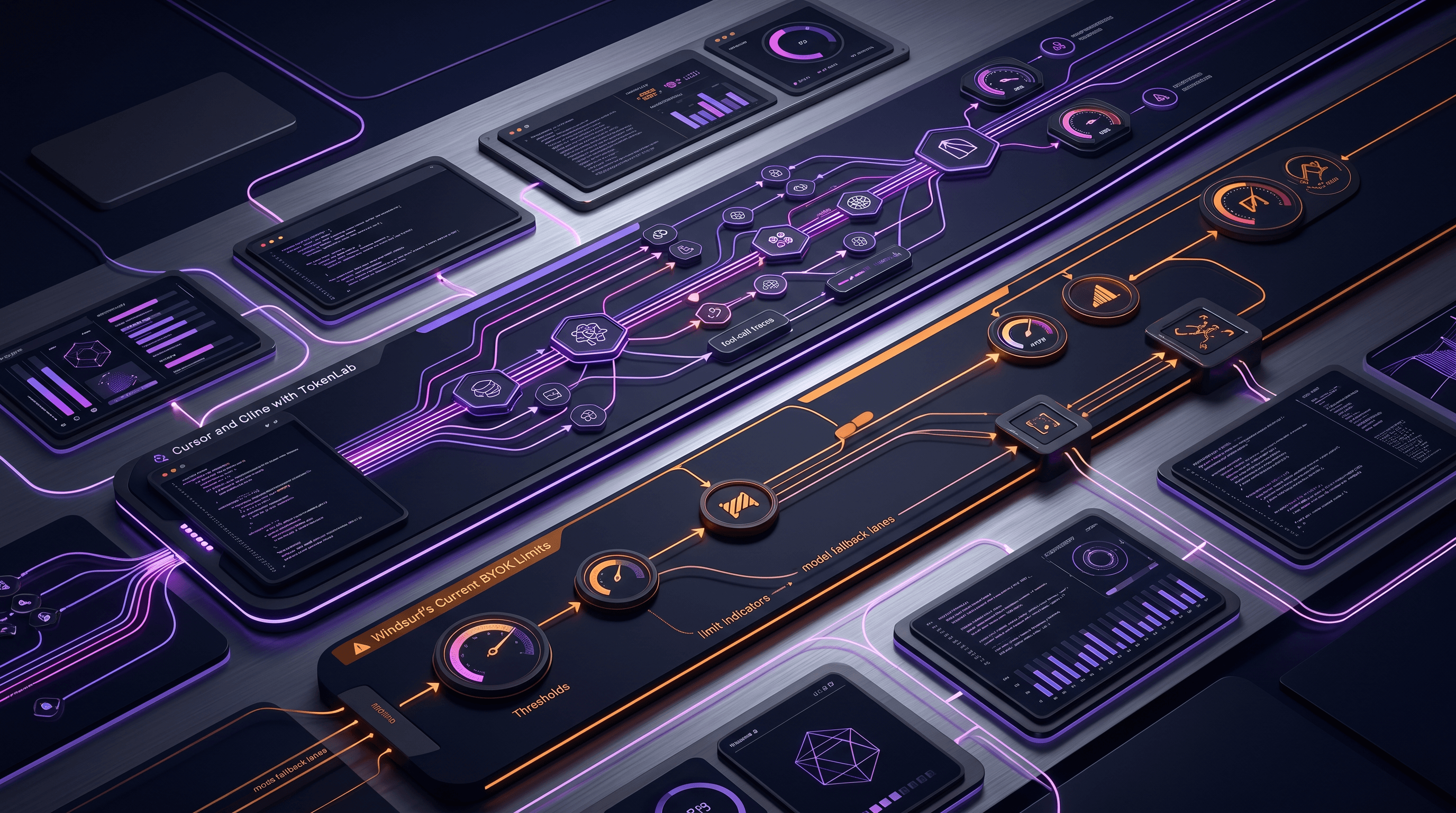
Windsurf is different from Cursor and Cline in an important way: it does not expose a generic OpenAI-compatible base URL override. Its BYOK support is scoped to specific Claude models on individual plans, and it is not a drop-in surface for arbitrary TokenLab-routed models.
Practically, this means:
- You cannot point Windsurf at TokenLab and get access to the full model catalog the way you can in Cursor or Cline.
- If your workflow depends on switching between Claude Sonnet 5, GPT-5.5, DeepSeek V4 Pro, and open-weight models like Qwen3.7 Plus in the same editor, Windsurf's current BYOK model is a limiting factor.
- Windsurf remains a reasonable choice if its built-in and BYOK-supported Claude models already cover what you need day to day.
Check Windsurf's own documentation for the current list of BYOK-eligible models before assuming parity with Cursor or Cline.
Choosing Models for Different Tasks
| Task | Recommended model | Why |
|---|---|---|
| Code review, refactors | Claude Sonnet 5 | Strong reasoning on existing codebases |
| Fast iterative scaffolding | DeepSeek V4 Flash or Gemini 3.5 Flash | Low cost, low latency |
| Long-context analysis | Gemini 3.5 Flash | Large context window at low cost |
| Autonomous coding agents | Kimi K2.7 Code or Claude Sonnet 5 | Tuned for multi-step agent workflows |
| Open-weight preference | GLM-5.2, Qwen3.7 Plus, DeepSeek V4 Pro | Self-hostable or provider-flexible options |
Verify current pricing for any of these models on the TokenLab model directory (observed 2026-07-07) before committing to a workflow, since rates change independently of this guide. If you're weighing cost tradeoffs across multiple providers, our pricing comparison covers how these models stack up on a per-token basis.
Setup checklist before you switch editors:
- TokenLab API key generated and tested with a curl request
- Base URL confirmed and copied into editor settings
- At least one fast/cheap model and one strong reasoning model added to your picker
- Anthropic-native mode enabled in Cline if you need extended thinking
- Windsurf BYOK docs checked if you plan to use it alongside Cursor or Cline
Recommendation
If you want full multi-model freedom across providers, set up TokenLab in Cursor or Cline. Both support arbitrary OpenAI-compatible endpoints and let you switch between Claude Sonnet 5, GPT-5.5, DeepSeek V4 Pro, and open-weight models like Kimi K2.7 Code without changing tools. Reserve Windsurf for cases where its built-in or BYOK-supported Claude models already match your needs, and don't expect it to behave as a generic multi-model gateway today.
Browse the current coding model category on TokenLab to pick your defaults before you configure either editor.
Get Started with TokenLab to route any of these editors through a single API key and access the current model lineup without managing separate provider accounts.
FAQ
Can Cursor use any model through TokenLab, or only the built-in defaults? Cursor's Override OpenAI Base URL setting lets you route to any OpenAI-compatible endpoint, including TokenLab. Once configured, you can add model identifiers for Claude Sonnet 5, DeepSeek V4 Flash, Gemini 3.5 Flash, or any other model available through TokenLab, not just the editor's built-in defaults.
Does Cline support extended thinking mode through a BYOK gateway? Yes. Cline supports the Anthropic-native protocol in addition to OpenAI-compatible mode. Selecting Anthropic as the provider and routing through TokenLab preserves extended thinking output for models like Claude Sonnet 5 and Claude Opus 4.8.
Why can't I use TokenLab as a generic OpenAI-compatible endpoint in Windsurf? Windsurf's current BYOK implementation is scoped to specific Claude models on individual plans rather than exposing an open base URL override. This is a platform limitation, not a TokenLab restriction, so check Windsurf's documentation for its current supported model list before assuming Cursor-level flexibility.
Sources
Price observed 2026-07-07
- TokenLab model directoryObserved 2026-07-07